Move Beyond the Hype: A Step-by-Step Guide to Embedding AI in Your Commercial Team

AI has reached every corner of B2B and B2G sales and marketing.
It’s in the conversations leaders are having, the tools vendors are selling, and the headlines flooding LinkedIn.
But for most commercial leaders, the potential, utility, and path to implementation remain hard to grasp.
Some hesitate because full automation feels overwhelming.
Some aim straight for a fully automated AI suite.
Others don’t believe automation will ever work for their business.
Underneath all of this sits a shared misconception:
Most teams believe the real value of AI only arrives when the entire commercial process is fully automated.
In reality, the value arrives much earlier — and for most organisations, it’s already happening.
Just not in a way that helps them win.
AI Is Already in Your Revenue Team
We see it all the time.
Salespeople, SDRs, marketers, and CS reps are carelessly pasting sensitive customer information into private ChatGPT windows.
They use it to summarise calls, clean up follow-ups, prepare for meetings, or brainstorm ideas when time runs out.
It’s fast.
It’s helpful.
And it’s completely disconnected from the rest of the commercial engine.
AI is already in your revenue team.
It’s just not creating structural value.
To make sense of what’s happening - and what actually works - we typically map AI adoption in commercial teams across four clear phases.
Some would argue that there are many more nuances to include, and they are likely right. This post aims to support teams working on sales-led commercialisation of B2B and B2G solutions in getting a sensible start to embedding AI into their commercial operations.
Here we go…
-> Phase 1 - Speed Without Structure
Unstructured use of standard LLMs
This is where most teams start - often without leadership knowing.
AI enters through individual initiative. Reps open ChatGPT and use it wherever friction appears in their day.
Example:
After a customer call, a seller pastes rough notes into ChatGPT and asks for a summary and a follow-up email.
It saves time. The email is better. The deal moves on.
The benefits
Faster writing
Better phrasing
Basic research support
Creativity boost for outbound and content
The risks
No GDPR governance
Sensitive customer data exposed
No alignment with your methodology or messaging
Disconnected from CRM and commercial systems
No organisational learning
This phase helps individuals — but does nothing for the organisation.
It’s speed without structure.
-> Phase 2 - The Contextualised Commercial Brain
Where AI becomes a shared asset
This is the turning point.
Instead of personal tools, AI becomes a shared intelligence layer - trained on your context and connected to your commercial systems.
The Commercial Brain understands:
Your ICP and segmentation
Your product and positioning
Your sales methodology
Your CRM data and customer conversations
This changes everything.
Sellers get real-time support inside live deals.
Marketing gets direct access to real buyer insight.
Product sees structured feedback from the field.
Leadership gains transparency across pipeline and execution.
This is where AI stops being helpful - and starts being commercial infrastructure.
At Fraymwerk, we have yet to work with a client where this layer wasn’t the single highest-impact AI investment.
-> Phase 3 - Contextual Brain + AI Agents
Efficiency without losing control
Once the Commercial Brain exists, organisations can safely layer in AI agents.
These agents don’t replace people.
They remove friction.
They handle repetitive tasks in the background - always aligned with your context and methodology.
Example:
After a discovery call, an agent updates CRM fields, highlights missing qualification elements, and drafts a follow-up aligned with the deal stage.
The seller reviews, adjusts, and moves on.
The benefits
Reduced admin workload
Cleaner CRM hygiene
More consistent pipeline management
Faster cadence and reviews
Clearer coaching
This phase is about efficiency - not automation for its own sake.
-> Phase 4 - Full Commercial Automation
The desired end state - for most.
This is where AI manages large parts of the commercial workflow end-to-end.
For many organisations, this is the goal.
But it only works if Phases 2 and 3 are already strong.
Without a solid intelligence layer, full automation risks scaling noise.
To make sense of what’s happening — and what actually works — we map AI adoption in commercial teams across four clear phases.
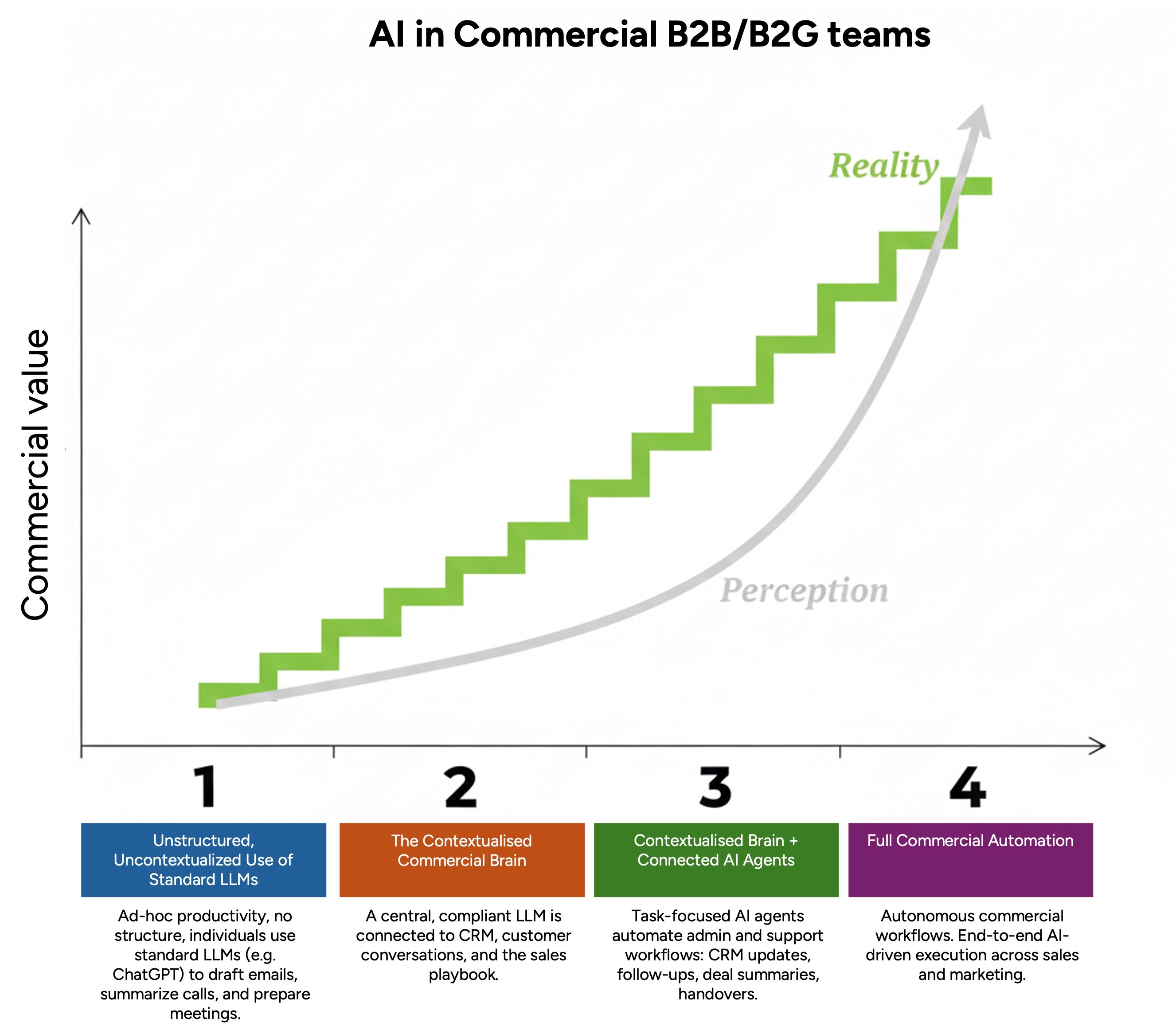
Let's talk about phase 2. This is where we see much of the initial (and compliant) value being generated for sales-led companies selling B2B and B2G.
Phases 1 and 4 get the attention.
Phase 2 creates the value.
It’s the lowest-risk, highest-return move most commercial teams can make with AI today.
It delivers:
Better deal quality
Faster onboarding
Stronger playbook execution
Less key-person dependency
More relevant marketing
Clearer signals to the product
Most importantly, it creates a foundation you can actually build on.
AI doesn’t fix broken commercial systems.
It amplifies them.
That’s why the path to real AI value doesn’t start with automation.
It starts with shared intelligence.
Build the Commercial Brain first.
Everything else becomes easier.
Want a Clear Starting Point?
If you want an honest view of where AI can create immediate value in your commercial engine — without hype or overengineering - we’re happy to help.
Fill out the form benefit or reach out via hello@fraymwerk.com // +45 3160 6016

Thomas Overholt Hansen
Founder & Partner at Fraymwerk
With 16+ years in B2B and B2G, Thomas has led commercial organisations across SaaS, technology, and other complex solution businesses, holding full P&L responsibility as CCO, CMO, and Business Owner.
Thomas has run enterprise sales, international expansion, revenue operations, and commercial teams across Europe and North America.
Thomas@fraymwerk.com
Direct: +45 3160 6016